Description
The most powerful image of Gnostic cosmology in Western art.
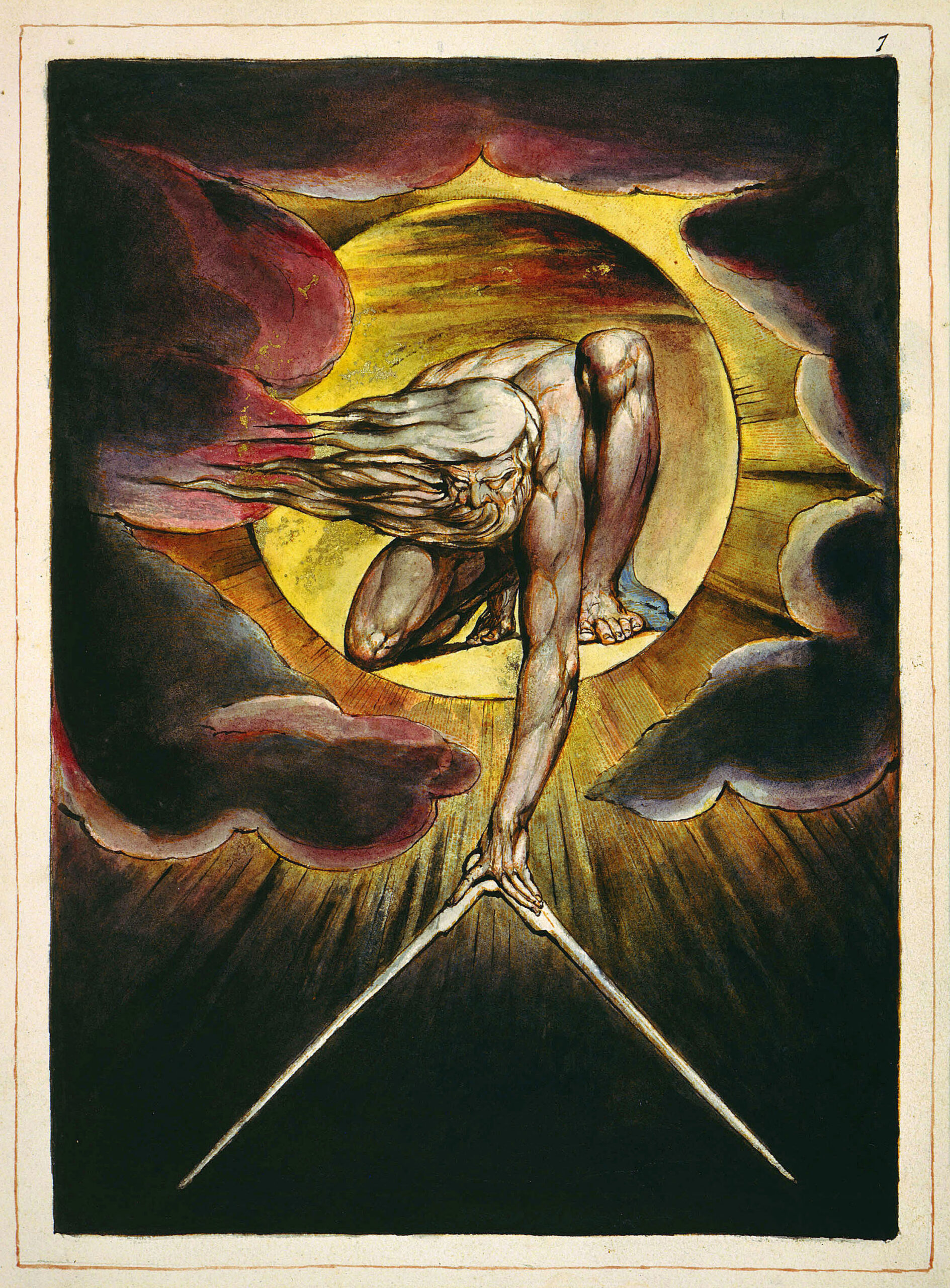
William Blake created this image as the frontispiece to his prophetic book Europe: A Prophecy in 1794. He returned to it obsessively for the rest of his life, producing hand-coloured versions well into his final years. On his deathbed in 1827, he was still colouring copies of this image.
What Blake was actually saying
The figure is Urizen — Blake’s name for the Demiurge, the false creator god of Gnostic mythology. Urizen reaches down from within a solar disk to measure creation with a compass. The gesture is simultaneously an act of creation and an act of limitation — imposing the rigid laws of reason and materialism on a reality that exceeds them.
Blake despised what he called “single vision” — the reduction of reality to what could be measured, calculated, and controlled. Urizen is the patron deity of that worldview. The Ancient of Days is not a celebration. It is a warning.
But Blake knew that warnings contain what they warn against. The image is undeniably magnificent. The figure is undeniably powerful. Blake was showing that even the false god has genuine grandeur — the grandeur of law, form, and proportion. The error is taking it for the whole.
For your space
This image functions as a Hermetic teaching object. It prompts the question: what are the compasses measuring in your life? What rules are you living inside without questioning their origin?
About this print
Museum-quality archival print. Public domain original (1794). Ships worldwide.